Prevention

Preventing Domestic and Sexual Violence in Virginia
Creating a world where relationships, families, and communities are healthy, equitable, and joyful requires us to address the root causes of domestic and sexual violence—not just respond after harm occurs.
We hold a radically hopeful vision for a future where all people can thrive, and where violence is not inevitable, but preventable. To that end, we work with communities across Virginia to promote healthy relationships, equity, and safety.Through training, public policy, and community partnerships, we are building a future free from violence.
Our Vision: Justice, Liberation, and Collective Well-Being

We believe a better world is within reach. A world where:
- People have what they need to reach their full potential
- Relationships, families, and communities are healthy, equitable, nourishing, and joyful
- Government, institutions, and systems are rooted in justice
- Decisions are guided by care for future generations and the Earth
Justice means communities most impacted by harm and inequity are centered in decision-making, with real power to shape solutions. It means individuals, families, and communities can define their own paths toward healing and wholeness, and that harm is addressed through survivor-centered accountability, reparations, and restoration.
Liberation is a future where all people are free, supported, and recognized in their full humanity and dignity; where we act from love and curiosity; where ancestors, the Earth, and all living things are honored as sacred and interconnected; and where communities thrive through nourishing human connection.
Our Approach: Comprehensive Primary Prevention

The Action Alliance works alongside local communities across Virginia to build comprehensive prevention strategies—from awareness and education to primary prevention and community mobilization.
Primary prevention means stopping violence before it occurs by addressing the conditions that allow it to happen. Because of its critical role in building safe, stable, and nurturing communities, the majority of our prevention technical assistance focuses on strengthening local capacity for effective primary prevention.
For an in-depth primary prevention resource, explore Fostering Community Resilience: Virginia’s Guidelines for the Primary Prevention of Sexual and Domestic Violence. These Guidelines support communities in addressing root causes of violence and draw from decades of statewide collaboration, including the original 2009 Prevention Guidelines developed by Virginia’s Primary Prevention Guidelines Work Group.
For more information, contact prevention@vsdvalliance.org.
PRIMARY PREVENTION
Primary prevention efforts change conditions (laws, norms, rules) so that perpetration is less likely to happen. Strategies are designed to shift attitudes, behaviors, and norms that support and perpetuate the root causes of violence and to promote healthy behavior and communities. Primary prevention strategies are designed to prevent initial perpetration. Best practice strategies will be saturated, theory-driven, address multiple levels of the SEM, rooted in anti-oppression, address risk and protective factors, and informed by community needs/resources.
Examples may include:
- Workshops series to explore and practice skills related to healthy sexuality, equity, communication, or other qualities important to young people’s developmental needs.
- Bystander intervention program that trains students and faculty to interrupt oppressive language and implements campaigns and/or policies to create a healthy and non-violent community climate campus-wide.
- Community-led projects that identify specific root causes of violence and long-term, sustainable strategies to build power in marginalized communities.
SECONDARY & TERTIARY PREVENTION
Secondary and tertiary prevention, often referred to as our advocacy direct services, aim to improve short- and long-term outcomes for survivors (and perpetrators). Secondary prevention efforts occur immediately following an instance of violence to reduce short-term harms, while tertiary prevention efforts are long-term responses intended to minimize lasting harms and promote resiliency. This terminology is helpful in building a connection between survivor services and primary prevention. A community culture that believes and supports survivors and holds perpetrators accountable is a necessary building block towards ultimately preventing violence. When primary, secondary, and tertiary prevention are used together, they create a comprehensive response to sexual and domestic violence.
Examples may include:
- On-going individual advocacy.
- Guidance & support in the legal system, especially around obtaining a protective order.
- Advocacy or therapeutic play groups for children who witness violence.
- Support groups.
- Offender management/treatment programs.
AWARENESS AND EDUCATION
Awareness and education programs increase people’s understanding of sexual and domestic violence. These strategies provide definitions, highlight the services offered in a community, describe the impact of violence, provide a scope of the prevalence, give information on how to help survivors, outline reporting options, and so on.
Examples may include:
- Community events such as a walk, fundraising gala, or survivor speak-out.
- Classroom sessions that present SA/IPV statistics, myths vs. facts, information about “date rape” drugs, how to support friends, and what students should do if they have experienced sexual assault or dating violence.
- Large group presentation (auditorium style) about warning signs and safety tips.
- A workshop for parents on what child sexual abuse is, how to identify signs of potential abuse, and how to make a report or access services.
RISK REDUCTION
Risk reduction strategies focus on changing the behavior of the prospective victim by helping people “avoid” experiencing victimization. These programs are not designed to change the problem of sexual and intimate partner violence perpetration. While individuals can make an investment in their personal safety, ultimately only perpetrators are in control of when, where, and how violence happens. These strategies do not change the problem of violence and can sometimes reinforce victim-blaming attitudes.
Examples may include:
- Workshop or educational materials on personal safety strategies such as the buddy system, watching your drink, and carrying keys in your hand.
- Self-defense classes for women.
- Bystander intervention programs that focus on intervening when violence is already in progress or likely to occur.

-
- YWCA Richmond
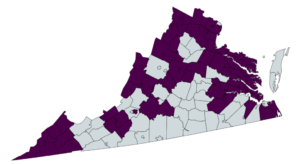
The map indicates the distribution of prevention funds from the Virginia Department of Social Services, Virginia Department of Health, and the Building Healthy Futures Fund (funded in part by proceeds from the sales of the Peace Begins at Home license plate).
-
- Abuse Alternatives (Bristol)
-
- Action in Community Through Services/Turning Point (Manassas)
-
- Alexandria Domestic Violence Program & Sexual Assault Center
-
- Avalon (Williamsburg)
-
- Bedford County Department of Social Services- Domestic Violence Services (Bedford)
-
- Center for Sexual Assault Survivors (Hampton)
-
- Choices (Page County)
-
- The Collins Center (Harrisonburg)
-
- Empowerhouse (Fredericksburg)
-
- Fairfax County Office for Women, Domestic Violence, and Sexual Violence Services (Fairfax)
-
- Family Crisis Support Services (Norton)
-
- Fauquier DSS DV Program (Fauquier)
-
- The Haven Shelter (Warsaw)
-
- Help and Emergency Response (Portsmouth)
-
- The James House (Petersburg)
-
- LAWS (Leesburg)
-
- The Laurel Center (Winchester)
-
- Project Hope, Thrive VA (New Kent)
-
- Project Horizon (Lexington)
-
- Safe Harbor (Henrico)
-
- Safehome Systems (Covington)
-
- Salvation Army Turning Point (Roanoke)
-
- Samaritan House (Virginia Beach)
-
- SARA (Charlottesville)
-
- Shelter for Help & Emergency/SHE (Charlottesville)
-
- Transitions Family Violence Services (Hampton)
-
- Women’s Resource Center of The New River Valley (Radford)
-
- YWCA Richmond
Our Prevention Projects & Campaigns
When families thrive, everyone succeeds. Family-friendly workplace policies help employees balance work and home life while strengthening health, stability, and long-term success for families and communities.
Experiencing sexual or intimate partner violence can create lasting barriers to economic security. Survivors often face missed work without pay, increased housing costs, and unexpected childcare expenses—burdens that fall especially hard on hourly and low-wage workers and on Black, Indigenous, and People of Color (BIPOC) employees, who are less likely to have access to supportive workplace benefits.
Families Thrive VA is a resource hub designed to help employers and communities advance violence prevention by strengthening economic and workplace supports. The site connects violence prevention and economic security and offers practical guidance in three priority areas: paid sick leave, paid family and medical leave, and access to childcare.
Families Thrive VA includes:
-
Clear language linking workplace supports and violence prevention
-
Policy recommendations in paid sick leave, paid family and medical leave, and childcare
-
Real-world examples and best practices from across the country
-
Downloadable resources to share with staff and partners
This work builds on the Family Forward NC initiative and was shaped by listening sessions with sexual and domestic violence agencies across Virginia. We will continue to expand the site with new research, case studies, and tools.
Explore Families Thrive VA, share it with your networks, and contact us to learn more about training and technical assistance. Together, we can build a Virginia where every family—and every survivor—has the support they need to thrive.
DO YOU: Building Youth Resilience Through Creative Expression is a primary prevention campaign for youth ages 13–16. Through creative expression and dialogue, DO YOU addresses dating and sexual violence, harassment, bullying, and their root causes while strengthening protective factors and resilience.
The campaign includes:
-
DO YOU – a 10-session curriculum combining discussion with arts-based zine creation
-
DO SOMETHING – a youth-led community action project that expands the program’s impact
Facilitators must complete a required two-day certification training to receive materials, ongoing support, and resources.
Supporting resources include facilitator guides, evaluation tools, youth organizing toolkits, and evidence-base documentation.
The Red Flag Campaign
The first statewide public awareness campaign addressing dating violence on Virginia’s college campuses, The Red Flag Campaign uses a bystander intervention approach to encourage peers to recognize warning signs and “say something” when they see red flags in a friend’s relationship.
Campus & Community Guides
Drawing on more than 35 years of gender-based violence prevention and response work, the Action Alliance has developed discipline-specific guides for:
-
Campus administrators
-
Advocates and first responders
-
Faculty and instructional staff
-
Campus law enforcement and security
-
Prevention specialists
Transforming Relationships Toolkit
This peer education toolkit supports student leaders and campus professionals in cultivating safer, thriving campus communities through foundational knowledge, frameworks, and practical activities.
Preventing sexual and intimate partner violence requires not only opposing harm, but actively envisioning and practicing healthy, joyful alternatives. A key part of our work is building consent cultures.
We define consent as a clear and enthusiastic “yes”—an active, voluntary, and verbal agreement that unfolds through conversation and mutual respect. Consent is not just about individual behavior; it exists within relationships, cultural norms, and societal systems. Building a consent culture means normalizing consent in everyday interactions.
Teach Consent / Ask. Listen. Respect.
Designed for youth ages 11–16, this campaign includes a short video and discussion guides that help young people understand consent, practice boundary-setting, and build healthy relationships. Materials can be used in classrooms, group settings, or one-on-one conversations.
Stay in the Know!

Want to know the latest news on prevention? Dive Into Prevention (DIP) is the Action Alliance’s semiannual newsletter highlighting prevention work. Each issue shares tools, resources, and insights that support efforts to prevent sexual and domestic violence and strengthen communities statewide. Subscribe to DIP and other Action Alliance newsletters today!